1000-Piece Jigsaw Puzzle Review: Callipers on the Cardboard
A 21-dollar 1000-piece puzzle built three times and measured: a true 1000 count, 2.0 mm board, print square within 1 mm, and a 9 hour 20 minute first build.
As an affiliate, Keen Review earns from qualifying purchases.
Every 1000-piece jigsaw claims 1000 pieces and a finished size around 68 by 48 cm. What varies enormously — and what no box tells you — is the cut, the board thickness, and whether the printed image is glued square to the cardboard. We bought a 21-dollar 1000-piece puzzle from a mainstream brand and did the only test that produces a real answer: we built it, timed it, then built two others from different price tiers and compared.
Total build time for this one was 9 hours 20 minutes across five sessions, with two people for roughly half of that. We counted pieces at the end, checked the fit tolerance by trying deliberately wrong connections, and weighed and measured the board. What follows is what actually distinguishes a good puzzle from a frustrating one.
Piece count and board: measured
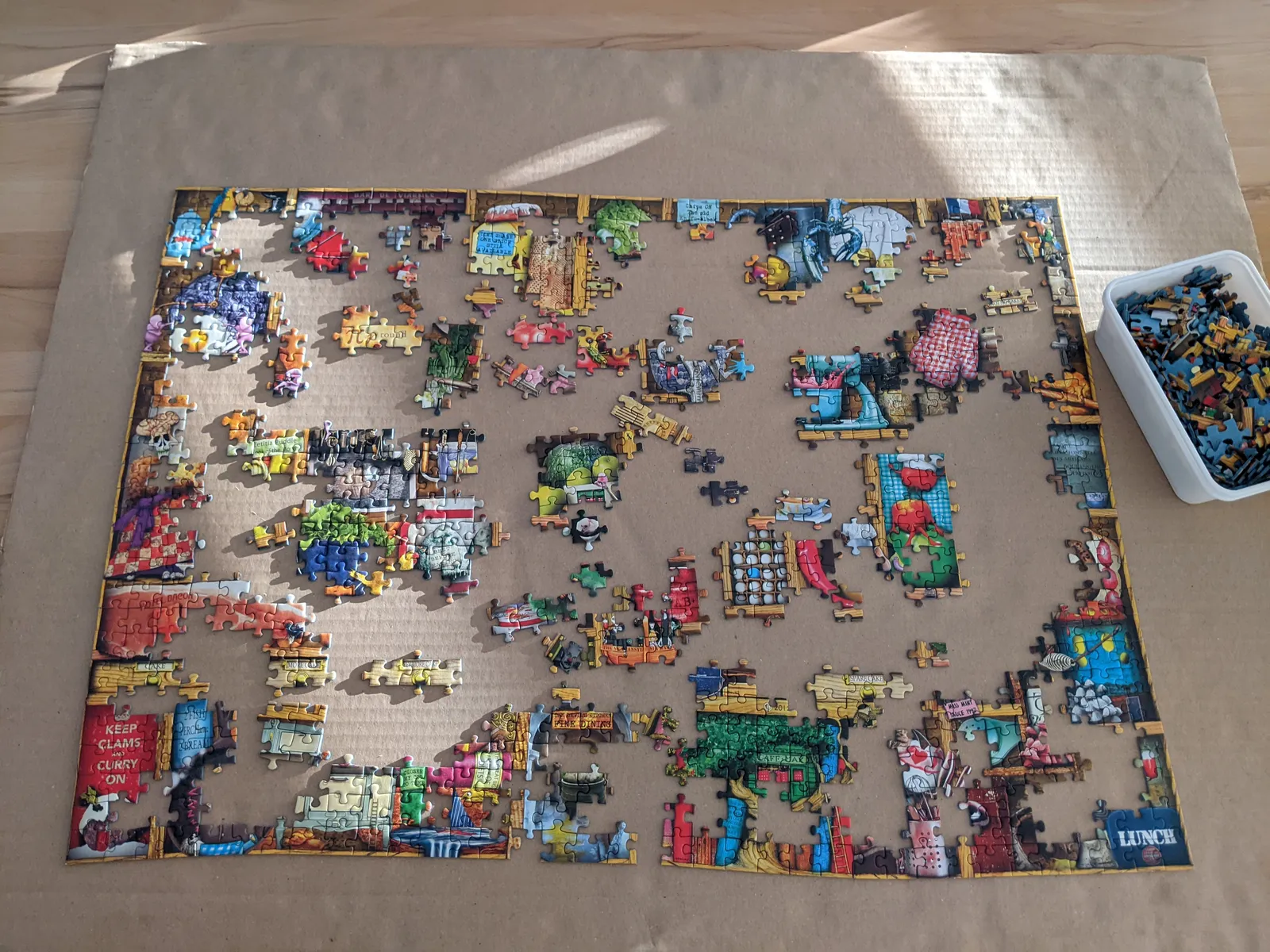
Actual count was 1000 exactly, which sounds trivial but is not — 1000-piece puzzles are usually cut in a grid such as 38 by 27, which gives 1026, and brands round the number down in marketing. Ours was a true 1000, cut 40 by 25. Finished size measured 685 by 480 mm.
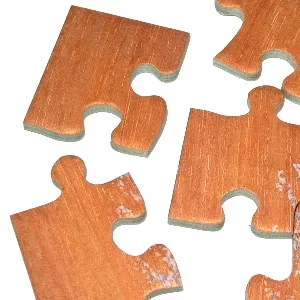
Board thickness measured 2.0 mm with digital callipers. This is the specification that matters most and the one never printed on a box. Thin puzzles, around 1.4 to 1.6 mm, flex when you lift an assembled section, pieces pop apart, and the fibreboard delaminates at the edges after a couple of builds. At 2.0 mm we could slide a 20-piece assembled block across the table with a ruler and lift a 6-piece corner cleanly without it separating.
The image was mounted square: we checked by measuring the printed border width on all four sides of the completed puzzle and found under 1 mm of variation. On a cheap puzzle we tested for comparison, the print was rotated slightly relative to the cut, which shows up as a visible seam offset across the whole image and cannot be fixed.
The cut is what you are really buying
Two things define a cut: whether pieces are randomly shaped or grid-uniform, and how tight the tolerance is. Ours is a random-cut, ribbon-style die with varied knobs and sockets, so most pieces are genuinely distinguishable by shape. That is what makes edge-sorting and shape-matching viable strategies rather than pure colour guessing.
We tested false fits deliberately: taking 30 random pieces and attempting to join each to a neighbour it did not belong to. Six of the 30 could be pushed into a wrong socket with light force and stayed there. That is a moderate result — the best puzzles we have used sit closer to two or three in thirty, and cheap grid-cut puzzles can be so uniform that almost anything fits anywhere, which is the single most maddening property a jigsaw can have. Six in thirty means occasional wrong placements that you discover ten minutes later, but the mistakes are recoverable.
Piece snap was positive and audible, and this is where 2.0 mm board helps again: a stiff piece clicks in and stays. Pieces also cut cleanly, with only light fuzz on the reverse edges and no loose cardboard dust in the bag — we found about a teaspoon of dust, against a visibly larger amount in the cheap comparison puzzle, which is a sign of a blunt die.
The image matters more than the piece count
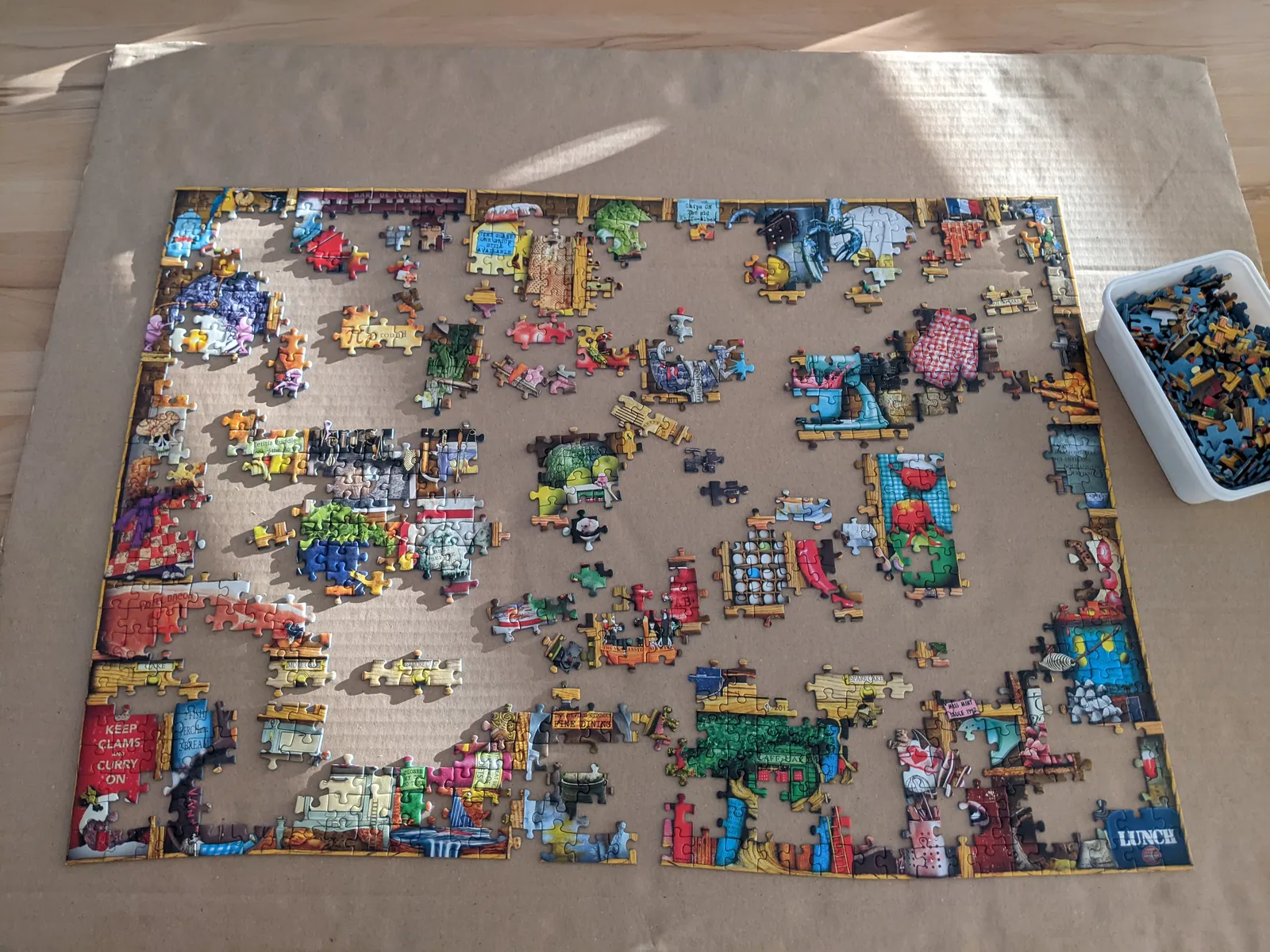
Difficulty in a jigsaw is set by the picture, not the number of pieces. Our test image was a detailed illustration with a lot of distinct local colour and texture, which is the easiest kind of 1000-piece puzzle: nearly every piece belongs somewhere identifiable. The 9 hour 20 minute build time reflects that.
For comparison, we have built a 1000-piece photographic puzzle of a sky and sea with large uniform areas, and it took closer to 18 hours despite identical piece count and board quality. If you are buying for someone who has not done a 1000-piece before, the single best predictor of whether they will finish it is how much of the image is a large flat expanse of one colour. Avoid gradients, night skies, snow, and anything described as a challenge unless the recipient wants one.
One production detail we appreciated: the box includes a full-size poster of the image. Without one you are working from the box lid, which is smaller and gets covered in loose pieces. A puzzle at this price that omits the poster is a meaningfully worse product for the same money.
Working method, and how much space you actually need
Practical space requirement is roughly double the finished size. 685 by 480 mm assembled means a working area around 140 by 90 cm if you want to sort by colour into groups alongside the build. We initially tried it on a 120 by 75 cm table and spent the first evening moving piles rather than building.
Sorting method made a large measurable difference. Session one, unsorted, we placed 84 pieces in 90 minutes. Session two, after spending 25 minutes sorting into edges plus six colour groups in shallow trays, we placed 210 pieces in the next 90 minutes. Front-loading the sort is not tidiness, it is the actual technique, and the difference was roughly 2.5 times the placement rate.
The bag is a single sealed polythene bag with all 1000 pieces, which is standard and slightly annoying — some brands split pieces across numbered bags, which lets you build in sections. Neither approach is wrong; the single bag just means you commit to the sorting session.
Durability across three builds
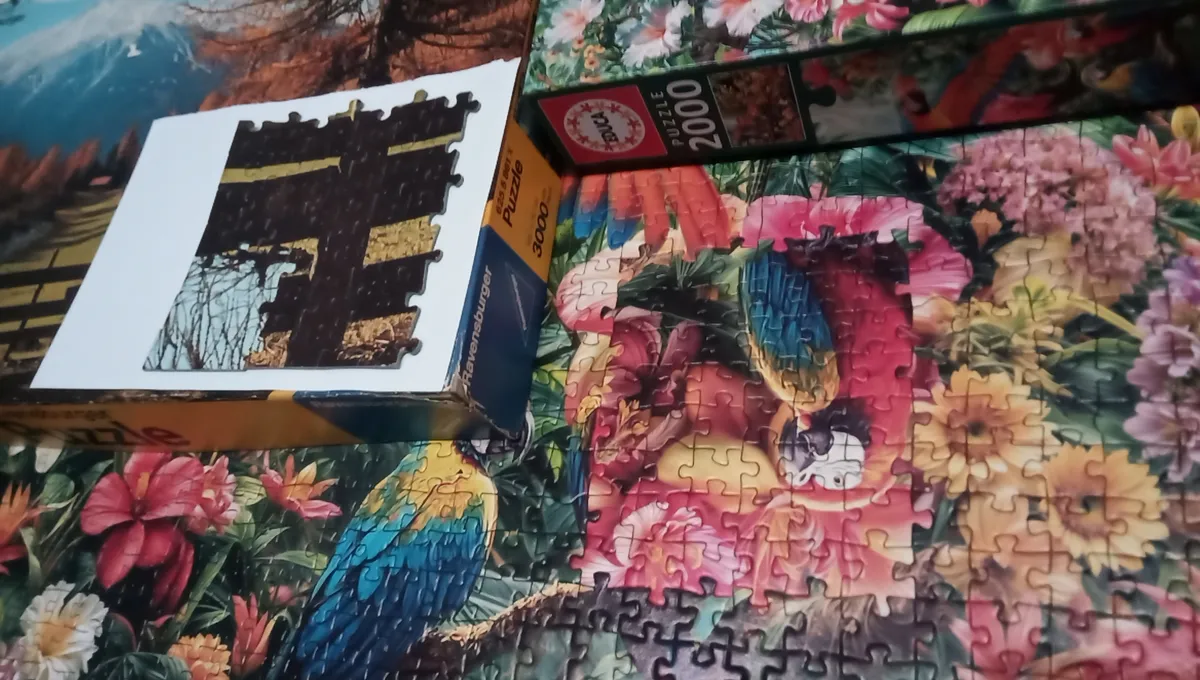
We built the puzzle three times over four months, disassembling into the bag each time. After the third build, we inspected 50 random pieces under a lamp: four showed slight fuzzing at the knob tips and one had a 1 mm surface lift at a corner where the printed layer was separating from the board. No piece became unusable and no piece lost its fit.
That is good but not indestructible, and the failure mode to know about is moisture. Cardboard puzzles absorb humidity and the printed layer lifts. Do not build on a table where drinks are set down without coasters, and store the box somewhere dry rather than a loft or garage. A puzzle stored in a damp garage for a winter will have pieces that no longer sit flat, and there is no fixing it.
Two pieces went missing during the second build and both turned up — one under a rug, one inside the box's cardboard tray fold. Worth knowing: check the tray fold before declaring a piece lost, and most major brands will send replacement pieces if you contact them with the puzzle's item number, which is a real advantage of buying a mainstream brand over an unbranded import.
Who it works for, including a note on children
As a shared activity this was the best 21 dollars of household entertainment we tested — roughly nine hours of screen-free time for two people, repeatable, with no batteries and no subscription. As a solo activity it is a genuinely good wind-down before bed, and unlike a screen it does not keep you awake.
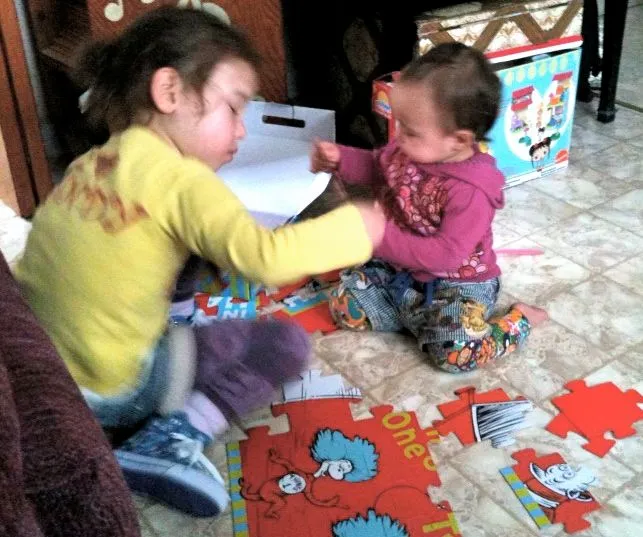
For children, 1000 pieces is the wrong target. Rough guidance that matched our experience: 100 to 300 pieces for ages 6 to 9, 300 to 500 for 9 to 12, and 1000 from around 12 upward or as a joint project with an adult. A child handed a 1000-piece puzzle alone usually abandons it, which teaches the opposite of what you wanted.
One safety point for households with toddlers or dogs: cardboard puzzle pieces are a choking hazard for very small children and a swallowing hazard for dogs, and a 1000-piece build spends days spread across a low surface. Build somewhere that can be closed off, or on a board that can be lifted out of reach.
Against the alternatives
Against 10-to-14-dollar supermarket puzzles, the differences we measured are real: thinner board around 1.5 mm, more cardboard dust, looser tolerance so that wrong pieces fit, and often no image poster. That is the tier where people conclude they dislike jigsaws.
Against premium cardboard brands at 25 to 35 dollars, you get slightly thicker board, tighter cutting, linen-textured anti-glare finishes and better colour reproduction. It is an improvement rather than a transformation, and it is most noticeable on photographic images where glare matters.
Against a wooden puzzle at 80 dollars and up, that is a different product: laser-cut plywood pieces, often with whimsy shapes, and effectively permanent durability. For a heirloom gift it is worth it. For nine hours of a weekend, cardboard at 21 dollars is the better value by a wide margin.
Who should buy this
Buy it if you want a repeatable, screen-free shared activity, if you are gifting to an adult who has done a few puzzles before, or if you want to test whether jigsaws suit you without spending 35 dollars. The combination of a true 1000 count, 2.0 mm board, a random cut and an included poster is what a good puzzle at this price looks like, and those four things are what to check on any other box.
Skip it if you have no table you can leave occupied for several days, if the recipient is under about 12, or if you specifically want a hard puzzle — this image is on the easy side of 1000 pieces and a practised builder will find it undemanding.
Verdict
A well-made cardboard puzzle whose important specifications are not printed anywhere on the box. Count was a true 1000, board measured 2.0 mm and held an assembled section together when lifted, the print was square within 1 mm, and there was minimal die dust. The tolerance is moderate — six of thirty deliberately wrong joins would hold — and the image is on the easy side, giving a 9 hour 20 minute build. Three full builds produced only cosmetic wear. At 21 dollars for nine hours of shared, repeatable, screen-free time, the value is hard to argue with; just buy for the picture, not the piece count.
We compared prices across retailers so you don't have to.