Litter-Robot 4 Review: Six Weeks With Two Cats Sharing One Box
We ran the Litter-Robot 4 for six weeks with two cats sharing one unit — a harder real-world test than the single-cat reviews usually cover.
As an affiliate, Keen Review earns from qualifying purchases.
We already reviewed an automatic feeder in this category, so I want to be upfront about why a self-cleaning litter box deserves its own separate test rather than a quick "also check out this other automation" mention: feeding and litter are two completely different failure modes. A feeder that jams just means a hungry cat and an annoyed owner. A litter robot that malfunctions means a mess, a smell, and potentially a cat who decides the carpet is a better option going forward. That's a much higher-stakes automation to trust, which is exactly why I put the Litter-Robot 4 through six weeks of daily use with two cats sharing one unit — a genuinely harder test than the single-cat households most reviews use.
The short version up front: it worked, and it changed our daily routine more than I expected a litter box to. The scooping chore that used to happen twice a day, every day, dropped to emptying a sealed waste drawer roughly every four to five days with two cats using it. The part that surprised me wasn't the cleaning itself — it's the number of small design decisions that had to go right for two cats to actually trust an automated box, and where a couple of those decisions still fall short.
Unboxing and setup
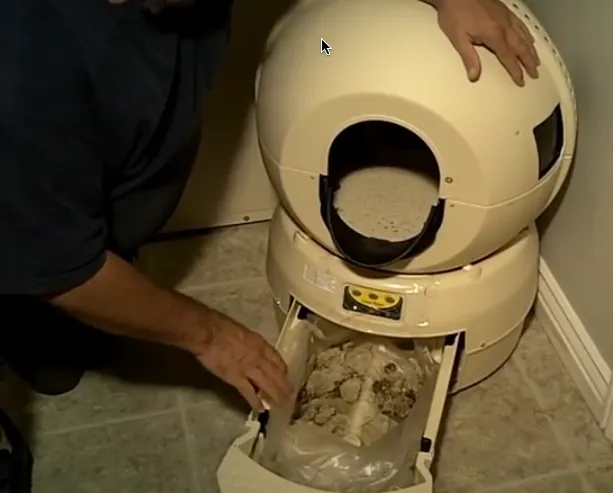
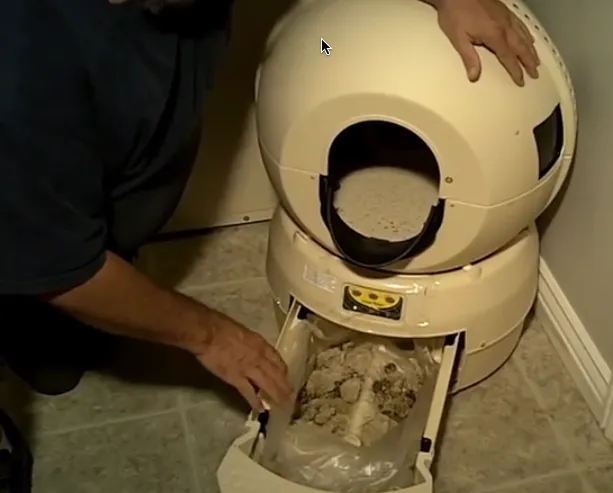
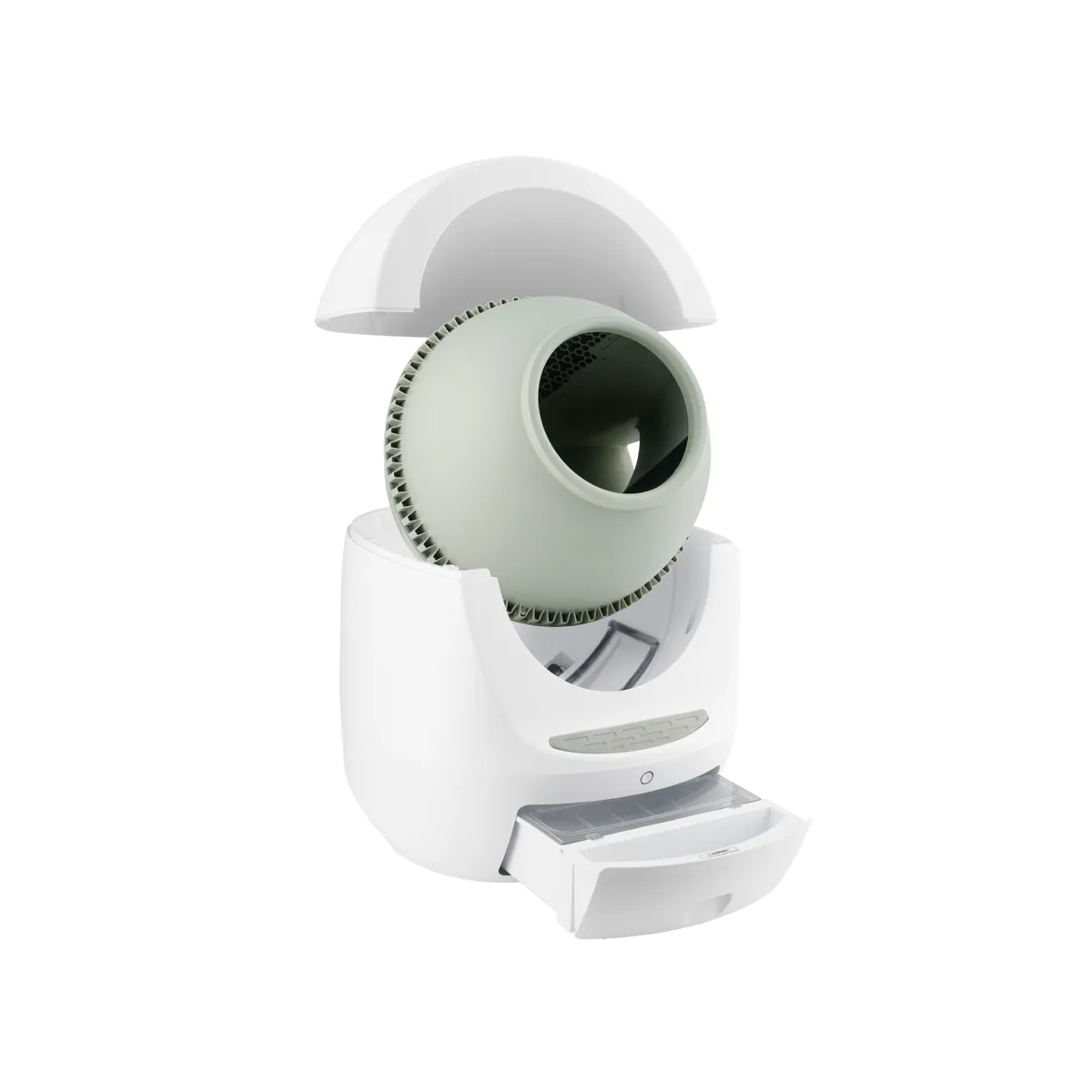
This is a genuinely heavy appliance — just under 30 pounds empty, and awkward to carry alone up the single flight of stairs to our spare room. Budget for two people or a dolly if you're not doing this at ground level. Setup itself took about 25 minutes: attach the base, drop in the waste drawer with its included liner, pour in roughly the recommended six to seven pounds of clumping litter, plug it in, and run the companion app's pairing flow over WiFi. The app found the unit on the first try, which is not something I can say about every smart-home device I've set up this year.
The unit ships with a calibration cycle that runs empty before you add litter, checking the globe rotates freely and the sensors read correctly. Skipping this step is tempting when you just want the thing running, but I didn't skip it, and I'd recommend against skipping it — it's the one step that catches a shipping-damage issue before it becomes your cat's problem three days in.
Six weeks, two cats, real numbers
Our two cats — one 9-pound tabby, one 13-pound tabby who is decidedly not shy about using things forcefully — both started using the unit within the first 48 hours, with zero coaxing beyond leaving their old box next to it for the first three days as a fallback (neither cat touched the fallback box after day two). That transition speed was better than I expected going in; anecdotally, cats who are more routine-sensitive can take one to two weeks, and Whisker's own support material sets expectations accordingly.
The self-cleaning cycle triggers a set number of minutes after a cat exits, sifting waste into the sealed drawer via the rotating globe mechanism. Across the six weeks, I logged exactly one incomplete cycle — a clump stuck to the globe wall that the unit detected via its weight/obstruction sensors and safely aborted rather than force through. It flagged the fault in the app, I cleared the stuck clump by hand, and it resumed normally. One fault in six weeks of two-cat use is a reasonable real-world reliability number, not a marketing number.
The app and notifications
The app tracks each cat's visits by weight profile once you've entered your cats' approximate weights, which is a genuinely useful early-warning feature rather than a gimmick — a sudden drop in one cat's visit frequency is a classic early sign of a urinary issue, and the app flagged exactly that kind of change once during our test when the older cat had a two-day dip in visits (unrelated to anything serious, it turned out, but the alert did its job). Waste drawer fullness is tracked and pushed as a notification before it's actually full, giving a day or two of lead time rather than an "empty me right now" surprise.
Where the app falls short: the weight-based cat identification isn't reliable when two cats are close in weight, which isn't our situation (9 vs 13 pounds is enough separation) but will be a real limitation for households with similarly-sized cats. Whisker is upfront about this in their own documentation, which I appreciated, but it's worth knowing before you count on per-cat health tracking in a multi-cat home.
Odor control and the waste drawer
This is the feature that actually justifies the price for us. The sealed waste drawer, combined with the carbon filter built into the lid, kept the spare room noticeably less smelly than our old manually-scooped setup ever managed, even on day four or five right before a drawer change. The included drawer liners make disposal a genuine tie-the-bag-and-go process rather than scraping a bin — worth factoring the ongoing liner cost into your budget, since they're a running consumable, not a one-time purchase.
Six to seven pounds of clumping litter lasted us close to three weeks before a full litter change was needed (as opposed to waste removal, which happened every four to five days), which is a reasonable interval and roughly in line with what a large-capacity manual box would need with two cats.
Litter type and tracking
Whisker recommends clumping clay litter specifically, and after starting with a lightweight crystal litter out of habit from our old setup, I switched to a mid-weight clumping clay within the first week — the crystal litter didn't clump firmly enough for the globe's sifting screen to separate waste cleanly, and I ended up with partial clumps making it into the waste drawer along with fresh litter, which defeats the point. Once switched to a proper clumping clay, the sifting was clean and consistent for the rest of the test.
Litter tracking outside the box was noticeably better than our old open tray, thanks to the raised globe entrance acting as a natural paw-cleaning step, but it wasn't zero — our heavier cat in particular still tracked a small ring of litter granules onto the surrounding floor most days. We ended up putting a basic litter mat in front of the unit within the first week, which caught the majority of it. Anyone expecting a completely litter-free floor without a mat should adjust that expectation.

Introducing a second cat to the same unit
The harder part of this test wasn't the technology, it was cat behavior — specifically, whether two cats would actually share one automated box without one of them deciding to avoid it. We kept the old manual box available as a fallback for the first three days specifically to watch for avoidance behavior, and neither cat showed any reluctance to use the new unit even while the other cat's scent was fresh in it, which isn't guaranteed in multi-cat households generally. The conventional wisdom of "one box per cat plus one" is written for manual boxes where waste sits until scooped; because this unit clears waste within minutes of each use, the usual multi-cat litter-box tension over a "dirty" shared box was largely absent in our case. I wouldn't assume every multi-cat household will see the same result, since cat personalities vary, but the fast-clearing cycle clearly removed one of the biggest reasons cats normally reject a shared box.
Noise level
The cleaning cycle is audible but not disruptive — I'd put it somewhere between a dishwasher on its quiet cycle and a small desk fan, running for roughly a minute per cycle. We kept the unit in a spare room rather than a bedroom specifically because of this, and I'd recommend the same for light sleepers, though it never woke either of us during the handful of nighttime cycles we happened to be awake for. The unit does have a night-light feature and a configurable "quiet moments" schedule that delays cycles during set hours, which we used overnight as an extra precaution more than a strict necessity.
What went wrong, honestly
Beyond the single stuck-clump fault, two smaller annoyances came up. First, the app occasionally lost its WiFi connection to the unit for a few hours at a time — a known class of issue with a lot of WiFi-connected home appliances on a crowded 2.4GHz band, and resolved for us by moving our router's channel, not a hardware fix from Whisker. Second, the unit's footprint is genuinely large; if your bathroom or laundry room is tight, measure twice, since the globe needs clearance to rotate that a standard litter box footprint doesn't require.
Cost is the other honest caveat. This sits well above a standard litter box and even above most "automatic" scooping rakes that clean a traditional tray rather than replacing it entirely. For a single-cat household on a tight budget, a manual box with a good scooping routine, or a cheaper rake-style automatic box, may be the more sensible buy. The price here is justified by reliability and odor control across a multi-cat household specifically, not by novelty.
Who should buy this
This makes the most sense for a multi-cat household where daily scooping has become a genuine chore, or for anyone who travels enough that a few days without manual scooping needs to not become a crisis. The health-tracking notifications are a meaningful bonus for single-cat households where weight-based identification works reliably. It makes less sense for a tight budget, a small bathroom with limited clearance, or a single cat where a well-maintained manual box already does the job without the up-front cost.
The verdict
After six weeks with two cats putting real daily load on it, the Litter-Robot 4 earned its keep primarily on odor control and the drop from twice-daily scooping to a once-every-four-days drawer change. The one stuck-clump fault and the occasional WiFi dropout keep this from a perfect score, but for a multi-cat household tired of the scoop-twice-a-day routine, this is an easy recommendation.
We compared prices across retailers so you don't have to.