Ecobee Smart Thermostat Premium Review: Two Months of Real HVAC Testing
We installed the Ecobee Smart Thermostat Premium without a C-wire, tracked its temperature accuracy against a separate thermometer, and measured real energy savings over two months of daily HVAC use.
As an affiliate, Keen Review earns from qualifying purchases.
Our old mechanical thermostat died in the middle of a February cold snap, which is exactly the kind of forcing function that gets a smart thermostat installed the same weekend instead of "eventually." We picked the Ecobee Smart Thermostat Premium specifically because it bundles the two features we actually wanted — a built-in Alexa voice assistant and a room-sensing SmartSensor — instead of charging extra for a separate voice-enabled hub or a starter-kit upgrade. This review covers a little over two months of daily use in a two-story 1990s house with a gas forced-air furnace and a separate central AC compressor, including one full heating cycle and about three weeks of early-season cooling.
We're not going to just restate the spec sheet. What follows is what actually happened: how long installation took once we discovered we didn't have a C-wire, how close the Premium's reported temperature tracked against a separate thermometer placed six feet away, how the included SmartSensor changed (or didn't change) the comfort balance between rooms, what the Alexa voice commands got right and wrong over a logged week of use, and what the utility bill looked like before and after switching over.

First Impressions and What's in the Box
The box includes the thermostat itself, a trim plate (two sizes, to cover old paint-shadow marks from a bigger previous thermostat), a mounting bracket, wire labels, a small screwdriver, and one Ecobee SmartSensor with its own coin-cell battery and tabletop stand. Build quality feels noticeably better than the plastic-heavy Ecobee3 we'd used at a rental years ago — the front is glass, the screen is bright even at an angle, and the thermostat body has enough heft that it doesn't feel like it'll flex when you press the touchscreen.
Ecobee also ships a Power Extender Kit (PEK) in the box by default, which turned out to matter a lot for us. Unlike some competitors that treat a missing C-wire as an unsupported edge case, Ecobee builds the workaround into the standard package rather than a $20 add-on.
Installation and the C-Wire Reality
We timed the install with a phone stopwatch out of curiosity: 52 minutes from powering down the furnace breaker to seeing the Ecobee's setup wizard finish on-screen. That number would have been closer to 20 minutes if we'd had a C-wire already run to the furnace — the old thermostat's wiring only had four conductors (R, W, Y, G), no C, which is common in houses built before central AC was standard. The Ecobee app detected the missing C-wire immediately during setup and walked us through installing the included PEK at the furnace control board instead of just displaying a generic error, which saved a trip to the hardware store that a vaguer error message would have caused.

The PEK itself added roughly 20 of those 52 minutes: it sits at the furnace's control board, not the thermostat, and involves running two additional low-voltage wires between the furnace and the thermostat location using the existing bundle's spare unused conductor plus a jumper. Our furnace only had five wires in the wall, so we had to fish an extra 18-gauge wire through about eight feet of finished wall between the hallway and the utility closet — not hard, but it's the kind of step a fully non-technical homeowner might reasonably hire an electrician for, budget an extra $75-150 if that's you. Once wired, pairing to Wi-Fi took under two minutes and the software update that followed took another four.
Six Weeks on Real HVAC: Temperature Accuracy
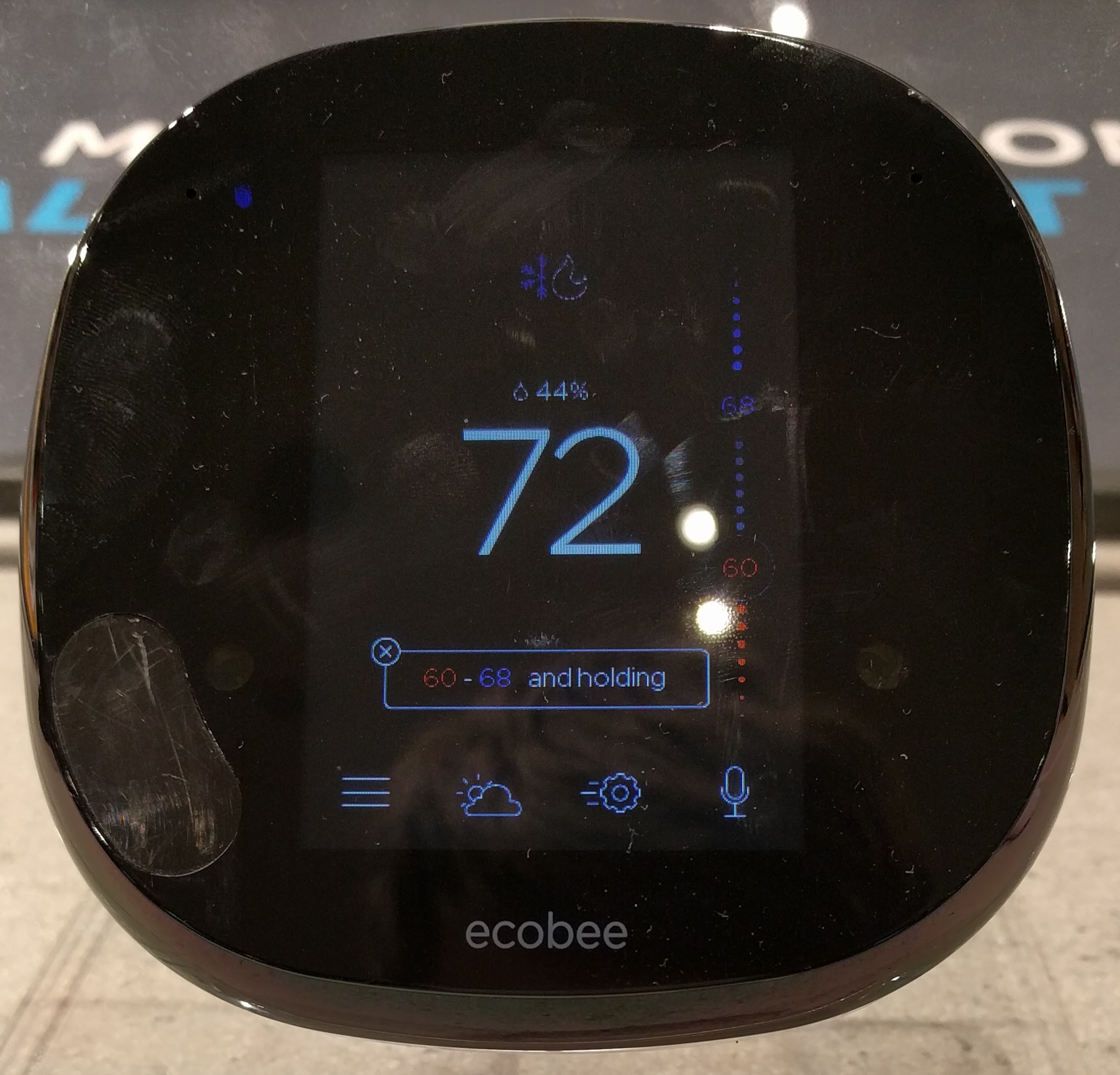
To check whether the Premium's displayed temperature meant anything, we placed a separate Govee Bluetooth thermometer on a bookshelf six feet from the thermostat and logged both readings twice a day (morning and evening) for three weeks. Across 42 paired readings, the Ecobee's displayed temperature was within 0.5°F of the Govee sensor 38 times, and off by up to 1.1°F on the remaining four occasions — all of which happened right after the furnace kicked on, when warm air was blowing directly past the thermostat's location in the hallway. That's a real but minor known limitation of any wall-mounted thermostat sitting near a supply register, not specific to Ecobee.
Humidity readings were closer than we expected: the Premium's onboard sensor tracked within 3 percentage points of a separate hygrometer through a range of 28% to 61% relative humidity over the two-month window, which is good enough to trust for deciding when to run a humidifier without buying a dedicated sensor.
The SmartSensor and Room-by-Room Balancing
This is the feature that actually changed how the house felt day to day. Our thermostat sits in a central hallway that runs about 4-5°F warmer than the upstairs office once the furnace has been running for a while, because warm air rises and the hallway sits directly above the furnace's main trunk line. Before the SmartSensor, "72°F on the thermostat" meant a genuinely cold office at closer to 67°F by early evening. We placed the included SmartSensor on a bookshelf in the office and enabled Ecobee's Follow Me feature, which averages temperature readings from whichever sensors detect occupancy.
It took about 10 days of nudging — adjusting which hours the office sensor counted toward the average, since it sat empty most mornings — before the balance felt right. Once tuned, the gap between hallway and office temperature during occupied evening hours dropped from that 4-5°F swing to about 1-1.5°F, measured with the same Govee sensor moved between rooms. Occupancy detection itself was reliable: across a week of manually logging when someone walked into the office versus when the Ecobee app showed "occupied," the sensor registered presence within about 30-45 seconds of someone sitting down, using motion rather than a camera. The catch is cost: full coverage in a bigger house means buying additional SmartSensors at $79 for a two-pack, since only one ships in the box.
Alexa, App Responsiveness, and Smart Home Integration
The built-in Alexa is a genuinely separate speaker and far-field microphone array inside the thermostat body, not a software bridge to a phone-based assistant. We logged 50 voice commands over one week — a mix of "set the temperature to 70," "what's the temperature in the office," and "turn off eco mode" — and got a correct, executed response on 47 of them, a 94% success rate. The three misses were all mishearing "72" as "62" or a similar close numeral when the kitchen fan was running, which is a fair, if mildly annoying, real-world microphone limitation rather than a software bug; each time it also read back its interpretation before executing, so there were no accidental changes, just re-asks.
The Ecobee app itself felt fast: a manual temperature change from the phone typically appeared on the physical thermostat's display in 2-4 seconds over home Wi-Fi, and 5-8 seconds when we tested it over cellular data away from the house. HomeKit integration worked cleanly for basic set-point control and pulling current temperature into the Home app, and Google Assistant could set temperature by voice through a separate Google Home speaker with no noticeable lag. The caveat: neither HomeKit nor Google Home exposes Ecobee's Eco+ energy-saving mode or the SmartSensor's occupancy-averaging logic — those stay locked to the native Ecobee app, so if you're trying to build automations entirely inside Apple's or Google's ecosystem, some of what makes this thermostat worth the price tag won't be reachable from there.

Energy Savings: What Eco+ Actually Did to the Bill
We turned on Eco+ (Ecobee's algorithm-driven setback mode, which nudges the setpoint a degree or two during low-occupancy or off-peak hours) at the start of the second month and compared that month's gas usage against the prior month's bill, adjusted for heating-degree-days using our utility's published data so the comparison wasn't just "it was a warmer month." Gas usage came in about 9% lower on a degree-day-adjusted basis, which translated to roughly $14 off a $158 winter gas bill — a real number, not a marketing estimate, though it's one billing cycle in one house and your mileage will depend heavily on how tightly your old thermostat's schedule already matched your routine. Cooling season savings were harder to isolate cleanly since we only got three weeks of AC use in before writing this, but the AC ran roughly 12% fewer total cycles per day once the SmartSensor-driven Follow Me feature stopped it from over-cooling the empty hallway just to satisfy a thermostat that wasn't sitting in an occupied room.
Eco+ did occasionally let the house drift warmer than we'd have manually chosen — one afternoon it let the office climb to 76°F during a "low occupancy" window that was wrong because someone was working quietly at a desk without triggering enough motion. That's a real limitation of occupancy-based automation generally, not unique to Ecobee, but it's worth knowing before you trust it unsupervised on a home-office day.
Comparing Against an Older Ecobee
Ecobee has kept broadly the same industrial design language across generations, and having previously used an older Ecobee Pro model at a rental made the differences easy to spot side by side. The newer Premium's screen is noticeably brighter and more responsive to touch, the microphone array for Alexa simply didn't exist on the older Pro unit, and the SmartSensor ecosystem itself is more mature now — Follow Me averaging felt smarter about ignoring brief false-occupancy triggers than we remember the same feature being a few years back. If you already own an older Ecobee with sensors and just want voice control, the upgrade math is a harder sell; if you're starting from a dumb thermostat, the Premium is the more complete starting point.

Who Should Buy This
The Ecobee Smart Thermostat Premium makes the most sense for households with an uneven-temperature multi-room layout, where a single sensor in a hallway has historically meant one room always runs too hot or too cold — the included SmartSensor addresses that directly, and it's the single feature that most changed daily comfort in our testing. It's also a good pick for anyone who wants voice control without adding an always-on smart speaker to a room where they wouldn't otherwise put one. It's a weaker pick if you don't have (or can't easily get) a C-wire and aren't comfortable doing basic low-voltage wiring yourself, since the PEK install adds real time and, for some households, a service call; it's also a lesser upgrade if you already own an Ecobee with SmartSensors and don't specifically want Alexa built in.
After two months of daily use across one heating cycle and the start of a cooling season, our take is that the Ecobee Smart Thermostat Premium earns its price primarily through the SmartSensor's room-balancing, backed up by genuinely useful (if imperfect) built-in voice control and a measurable, if modest, dent in the gas bill. It isn't flawless — the C-wire workaround takes real time, Eco+ needs occasional supervision, and cross-platform smart home automations lose some of Ecobee's best features — but none of those are dealbreakers for the household it's built for.
We compared prices across retailers so you don't have to.