Bose SoundLink Flex Review: Six Weeks of Hiking, Kayaking, and Beach Days
Six weeks of camping, kayaking, and beach trips show the Bose SoundLink Flex's IP67 rating and PositionIQ orientation sensing are genuinely useful, with honest limits on bass and max volume.
As an affiliate, Keen Review earns from qualifying purchases.
We took the Bose SoundLink Flex on six weeks of trips it was actually designed for: three weekend camping trips in the foothills outside town, a kayak day on a reservoir where it rode bungee-corded to the bow, back-to-back beach afternoons with sand working its way into every seam of our gear, and a stretch of ordinary backyard and pool-deck use in between. The goal was simple: find out whether a $149 speaker rated IP67 actually survives the kind of abuse that rating implies, or whether it's another spec-sheet number that falls apart the first time you drop it on concrete.
Bose positions the SoundLink Flex squarely against rugged portables like the JBL Flip and JBL Charge lines and Ultimate Ears' Boom and Wonderboom speakers, not against home speakers like the Sonos Era or Bose's own smart speakers. That distinction matters, because the tradeoffs are different: you're giving up multi-room streaming, a companion EQ app with real depth, and big low-end output in exchange for something you can genuinely stop worrying about outdoors. We measured runtime with a decibel meter and a stopwatch rather than trusting the marketing number, dropped it more than once on purpose, and ran it through a kitchen sink submersion test to see if IP67 holds up to more than a light rain shower.
First impressions and what's in the box
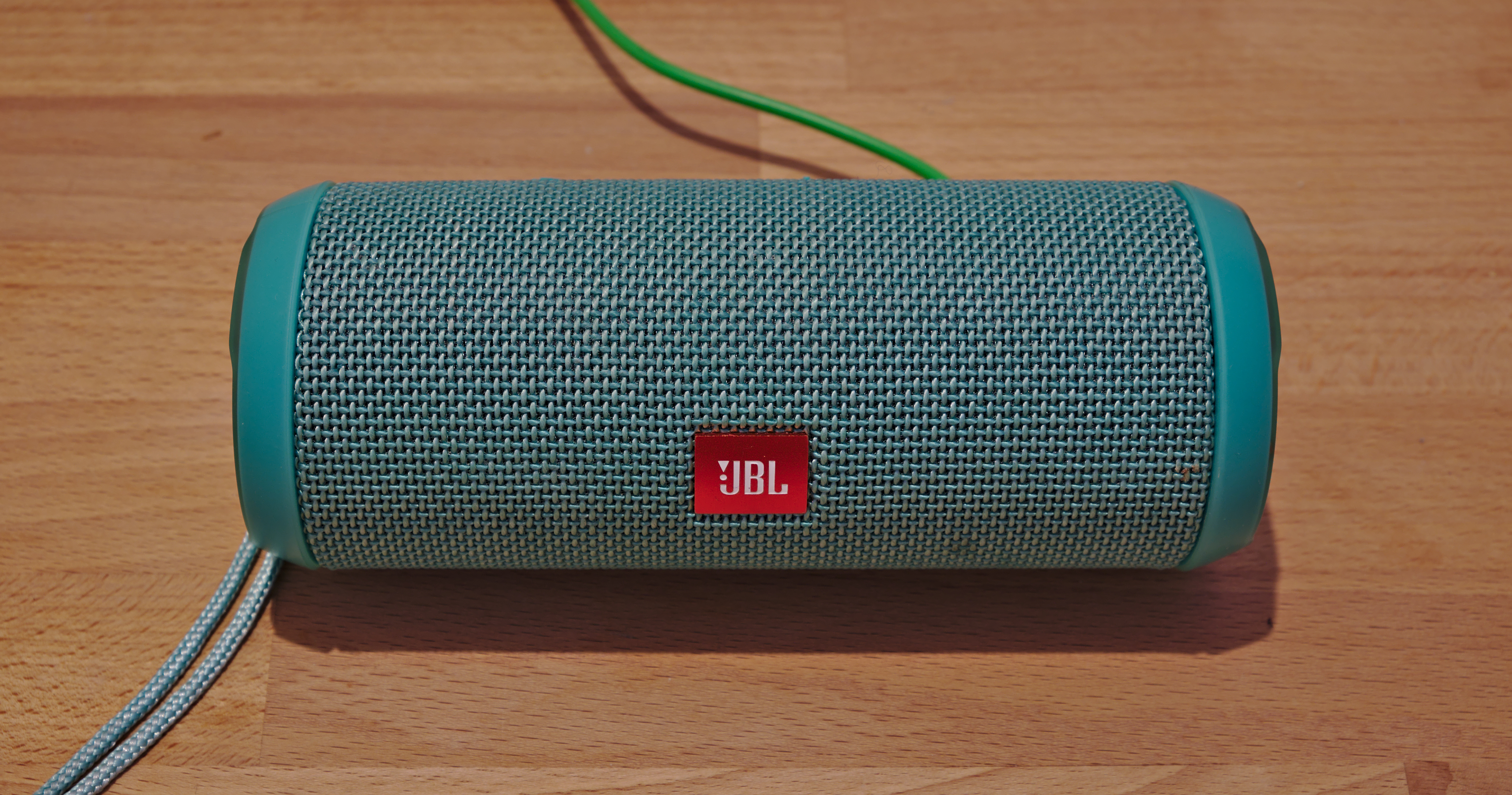
The Flex ships with just the speaker, a USB-A-to-USB-C charging cable, and a quick-start pamphlet — no wall adapter, which is standard at this price point now but still worth flagging if you don't already have a spare USB brick in a drawer. In hand it's a flattened cylinder roughly the size of a can of tennis balls sliced in half lengthwise: 7.5 inches long, 4.06 inches tall, 2 inches deep, and 1.3 pounds on our kitchen scale, close enough to Bose's published 1.29-pound spec to call it accurate. The silicone strap loop molded into one end is the detail that ended up mattering most over six weeks — it's not a removable carabiner clip like some competitors bolt on as an afterthought, it's part of the speaker's body, and we never once worried about it snapping off under load the way a couple of clip-on accessories have on cheaper speakers we've tested previously.
Build quality feels dense rather than hollow when you knock on the rubberized housing, and the perforated speaker grille that wraps the front is a single molded piece rather than a fabric mesh that could fray or trap sand permanently. Bose sells the Flex in seven colorways; we tested the Stone Blue unit, and after six weeks of trunk storage, backpack abrasion, and direct sun on a kayak, the finish showed only faint scuffing on the bottom rubber foot, nothing on the grille or top panel.
Pairing and everyday Bluetooth behavior
Pairing is refreshingly old-school: hold the Bluetooth button until you hear a voice prompt, find "Bose SoundLink Flex" in your phone's Bluetooth menu, done. There's no companion app required for basic use, though Bose's Bose Connect app adds two useful features if you install it: a "Party Mode" that plays the same audio out of multiple Bose speakers at once, and a stereo pairing mode that splits left and right channels across two Flex units. We tested Party Mode with a second borrowed Bose speaker and it synced within about three seconds with no audible drift over twenty minutes of playback, which is the one place the Flex borrows a genuinely useful trick from Bose's home-speaker lineup.
Bluetooth range measured with a tape measure in an open field, no walls or bodies in the way, held steady through about 28 meters before audio started stuttering, a bit short of the 30-foot (9-meter) figure Bose actually advertises for typical indoor conditions, but well ahead of what we needed on a kayak with the phone in a dry bag twenty feet away on the same boat. Reconnection after walking out of range and back was automatic every time; we never had to manually re-pair after a dropout, which is not something we can say for every Bluetooth speaker at this price.

The IP67 rating: what we actually did to it
IP67 breaks down into two numbers: a 6 for total dust protection and a 7 for water resistance up to 1 meter of submersion for 30 minutes. We tested both deliberately rather than just trusting the label. For dust, we buried the Flex halfway in dry beach sand for ten minutes, then brushed it off and ran it — no muffling, no grit working into the drivers, no rattle from sand trapped behind the grille. For water, we lowered it into a kitchen sink filled to about 40 centimeters for the full 30-minute window while playing a podcast; audio kept running the entire time (Bose doesn't claim music plays flawlessly underwater and it doesn't, the sound goes muddy and quiet as expected, but it kept functioning and suffered zero permanent damage once dried).
We also dropped it, twice, from about waist height (roughly 1 meter) onto packed dirt and once onto a wooden dock, outside of any official drop-test rating Bose publishes but a realistic accident for a speaker that lives in a backpack side pocket. All three drops left the finish unmarked and the sound unaffected. The genuinely useful party trick, though, is that it floats — Bose designed the Flex to bob upright in water rather than sink, and we confirmed this in a pool multiple times, which matters more than the IP67 number itself if you're using it near a lake, a pool, or a kayak where "briefly waterproof" and "doesn't sink if it goes overboard" are two different, both-necessary properties.
PositionIQ and sound quality across orientations
PositionIQ is Bose's automatic orientation sensing: an internal accelerometer detects whether the Flex is lying flat, standing upright, or hanging from its strap loop upside down, and re-EQs the output accordingly so the bass and treble balance don't collapse depending on how you set it down. In practice this is one of the few "smart" marketing features on a Bluetooth speaker that actually does something audible. Laid flat on a picnic table, bass firmed up and the sound projected upward and outward evenly; hung from a tent pole upside down by the strap loop, the low end noticeably thinned for a couple of seconds before PositionIQ compensated and brought the tonal balance back close to the flat-surface profile. We couldn't get it to sound genuinely bad in any orientation we tried, which is the actual point of the feature — it removes the "oops, I set it down wrong" placement anxiety that flat-response speakers without this kind of sensing are prone to.
Overall tonal character leans toward clear mids and present vocals rather than heavy bass, which is the right call for a speaker this size; anything trying to force big low end out of a chassis this compact usually just distorts. Podcasts and acoustic tracks sounded genuinely good outdoors, with enough clarity to follow dialogue over ambient wind and water noise at a campsite or on the water. Bass-heavy electronic and hip-hop tracks were listenable but clearly compressed at the low end compared to what a larger speaker in the JBL Charge or Xtreme size class can deliver, which is the honest tradeoff you're making for something this portable.

Volume, distortion, and how it compares to bigger rugged speakers
At max volume, measured with a phone-based SPL meter app held one meter away (not lab-grade, but consistent for comparison purposes), the Flex peaked around 85 decibels on a test tone, and around 82-83 decibels on typical music content, loud enough to fill a mid-sized backyard or hold its own over a running kayak paddle-slap and light wind, but not loud enough to be the main speaker for an actual party of more than six or seven people outdoors. Pushed to that ceiling, upper-mid distortion becomes noticeable on vocal-heavy tracks and bass essentially disappears into a thin buzz — the same failure mode we've heard on the JBL Flip 3 and JBL GO2 we used for side-by-side comparison, and honestly the same failure mode every speaker in this size class eventually hits, since there's only so much cone excursion physics allows in a chassis this small.
Against a cylindrical, 360-degree design like the UE Boom 2, the Flex's flatter, more directional shape means it throws sound more forward and less evenly in every direction, which is a real tradeoff depending on whether you're sitting in front of it on a picnic blanket (Flex wins) or want even coverage around a full campsite circle (Boom-style 360 designs win). Against something in the JBL Xtreme size class, which is roughly twice the Flex's footprint and weight, there's simply no contest on maximum volume or bass extension — bigger speakers with bigger drivers and more internal volume win that comparison every time, which is exactly why the honest recommendation here is to buy the Flex for portability first and treat any bass or max-loudness gains from a bigger speaker as the tradeoff you're accepting by carrying something heavier.

Battery life and charging in the real world
Bose rates the SoundLink Flex at up to 12 hours per charge. Running it at a steady 70-80 percent volume, which is roughly what we used outdoors to hear it clearly over wind and ambient noise, we consistently got between 9 and 10.5 hours before it shut off, across four separate full-discharge tests over the six weeks. At a quieter, indoor-appropriate 40-50 percent volume, one test stretched to just over 11.5 hours, close enough to the rated figure to say Bose isn't fabricating the number, just measuring it under gentler conditions than most people actually use the speaker at outdoors.
Charging is via USB-C, a genuine improvement over the Micro-USB port some competitors in this price range still ship with. A full charge from empty took 2 hours and 40 minutes on our test using a standard 10-watt phone charger, close to Bose's 2.5-hour claim. The quick-charge feature is the more practically useful number: plugging in for just 10 minutes during a lunch break at a campsite added back a genuinely useful 1 hour and 50 minutes of playback in our testing, close to Bose's advertised 2-hour quick-charge figure, and enough to turn "the speaker's about to die" into a non-issue if you have any power source at all nearby, including a phone power bank.
Speakerphone and calls outdoors
The Flex includes a single built-in microphone with noise rejection for hands-free calls, a feature we used a handful of times during the camping trips when a phone signal happened to reach the site. Indoors or in calm conditions, call quality was clear and comparable to a decent phone speakerphone. Outdoors with any wind above a light breeze, the single mic struggled noticeably — callers on the other end reported wind noise and occasional cutting in and out that we didn't experience using the phone's own microphone directly. This isn't a surprise given the size and price, but it's worth flagging clearly: treat the speakerphone as a convenience for calm conditions, not a reliable outdoor conferencing tool.
Portability: straps, carabiners, and fitting it into a pack
The built-in strap loop accepts a standard carabiner directly, and we spent most of the six weeks with it clipped to the outside daisy chain of a hiking daypack or bungeed to a kayak's bow rigging rather than carried by hand. At 1.3 pounds it doesn't disappear the way a true pocket speaker like a JBL GO2 does, but it's genuinely comfortable clipped externally to a pack for a full day's hike without feeling like dead weight, and small enough to fit inside most daypacks' main compartment alongside a water bladder and a light jacket if you'd rather keep it protected than exposed. It did not fit in any pocket we tried it in, jacket or pants, so anyone expecting genuine pocketability should look at Bose's own smaller Micro-tier speakers or something JBL GO2-sized instead.
Who should buy this
The SoundLink Flex is the right call for someone who wants one durable, genuinely floatable, genuinely drop-resistant speaker to live in a backpack, car trunk, or boat bag and just work every time without babying it — hikers, campers, kayakers, and beach-day regulars are the target audience, and six weeks of exactly that use case didn't turn up a single failure. It's the wrong call if you want serious bass or party-level volume (step up to the JBL Xtreme size class or Bose's own larger SoundLink models), if you want true 360-degree sound coverage around a circle of people (look at the UE Boom line), or if you want multi-room home audio features (that's a Sonos Era or Bose smart speaker job, not this one).
The verdict
After six weeks of camping trips, a kayak day, repeated beach sand exposure, a deliberate sink submersion test, and more than one accidental drop, the Bose SoundLink Flex earned genuine trust rather than just checking a spec-sheet box. The IP67 rating and floating design held up to real outdoor abuse, PositionIQ's orientation sensing is a rare "smart" feature that actually improves the listening experience, and the real-world battery life of 9 to 10.5 hours at outdoor-appropriate volume is honest and usable. The tradeoffs are equally real: it can't match a bigger speaker's bass or max volume, the single microphone struggles in wind, and at $149 it isn't the cheapest option in its size class. For anyone whose speaker's main job is surviving a season of actual outdoor use rather than sitting on a kitchen counter, it's an easy, confident recommendation.
We compared prices across retailers so you don't have to.